
Lucky Vegas Verification and KYC UK
 Available in GB
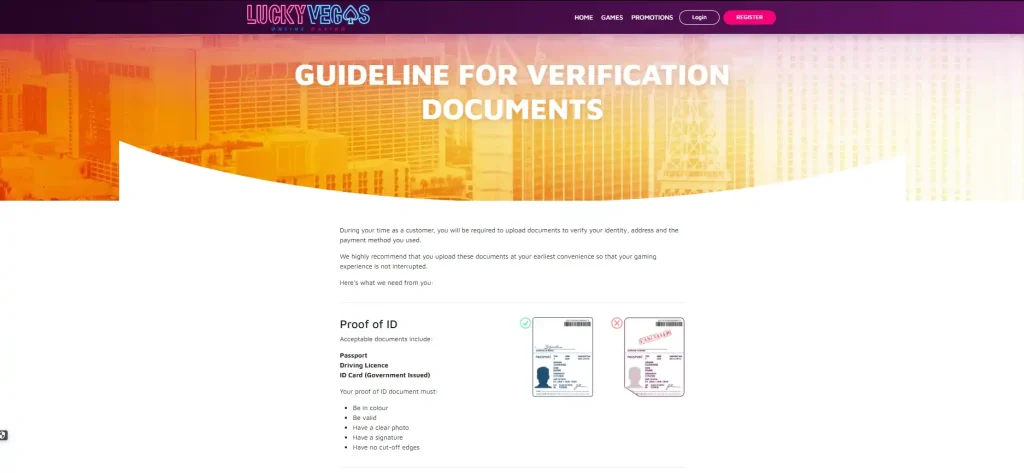
Lucky Vegas verification guidance covers document upload and the checks used for identity, address and payment ownership.
Lucky Vegas can ask a Great Britain customer for proof of identity, proof of address and proof connected to a payment method used on the account. Accepted examples include a passport, driving licence or government-issued ID card for identity, and a utility bill or bank statement for address. Payment-method documents may also be requested when relevant.
The operator’s document guidance says uploaded documents are usually checked in under 12 hours, but extra verification can make the review take longer. It advises contacting support if there has been no response within 48 hours. Those timings describe document review, not a guaranteed withdrawal deadline. Great Britain rules also require online gambling businesses to verify age and identity before a customer gambles.
Why Lucky Vegas asks for verification
Verification serves more than one purpose. At the basic account level, a licensed remote casino must establish who the customer is and make sure the customer is old enough to gamble. The UK Gambling Commission says online gambling businesses must ask customers to prove age and identity before gambling. The minimum identity framework for remote licensees includes name, address and date of birth, although an operator can need additional information when legal, security or payment checks require it.
That means KYC should not be understood as a single event that happens only when a customer presses the withdrawal button. Some customers can be verified electronically from the information supplied during registration. If electronic checks do not provide enough confidence, the operator can ask for documents. Further checks can also arise later if account details change, a new payment method is introduced or another legal obligation needs to be satisfied.
Accurate account details make verification simpler. The registered name and address should match the documents supplied, and the payment method should belong to the account holder. Old addresses, inconsistent spellings or another person’s payment instrument can trigger extra checks.
For the signup sequence itself, see Lucky Vegas Registration and Account Setup. Additional documents can be requested after the initial account checks. The examples below cover common requests, although the exact documents can vary by account.
Identity and address evidence
Lucky Vegas groups the main document requests into proof of identity and proof of address. For identity, the operator lists government photo documents such as a passport, driving licence or government-issued ID card. The purpose is to connect the account to a real individual and allow the operator to compare the submitted evidence with the personal details already held on the account.
For proof of address, Lucky Vegas lists a utility bill or bank statement. The document needs to clearly connect the named customer with the address registered on the account. A document that is unreadable, incomplete or tied to an old address can trigger follow-up even if it belongs to the right person. Customers should therefore check that the evidence answers the actual request rather than uploading the first official-looking file they can find.
These categories should not be treated as a promise that Lucky Vegas will ask every customer for exactly the same items. The Gambling Commission does not prescribe one universal document list for every operator and every case. Electronic verification may be enough for some customers, while others can be asked for copies because the available databases do not resolve the check. Account-specific legal or risk questions can also require additional evidence beyond the basic examples.
A useful rule is to read the request literally. If the operator asks for identity evidence, send an accepted identity document. If it asks for address evidence, choose a document that clearly shows the required address information. Avoid replacing a requested category with an unrelated file simply because it is easier to obtain. A clear, current and complete document is less likely to be returned for correction.
Payment-method evidence
Lucky Vegas can also request proof connected to a payment method when it is relevant to the account. This is separate from proving that the customer exists at the registered address. The operator may need to establish that the person controlling the gambling account is also legitimately using the funding method connected to deposits or withdrawals.
Payment ownership matters because mismatched ownership can create fraud, chargeback and anti-money-laundering concerns. A customer who uses a payment method in somebody else’s name can therefore create a more complicated verification path than a customer whose account and payment information align. The safest practical setup is to use payment methods that belong to the account holder and to keep the registered personal details accurate.
The required payment document can depend on the method. Follow the request shown in the Lucky Vegas account area; a debit card, bank account or wallet may call for different proof, so submit evidence for the actual payment method connected to the transaction.
Before uploading, compare the account details with the document itself. A clear file that answers the requested category is more useful than several unrelated files: identity documents should identify the customer, address documents should support the registered address, and payment documents should relate to the method being checked. If the request changes, follow the newer account instruction rather than repeating an earlier submission.
Sensitive documents should be supplied only through the official route identified by the operator. Do not send identity or payment records to addresses copied from unrelated review sites, social media posts or private messages. A verification page contains highly personal information, so the destination matters as much as the file itself.
Uploading documents and review timing
The current Lucky Vegas verification guidance says uploaded documents are usually checked in under 12 hours. It also says a review can take longer when extra verification is needed and recommends contacting support if there has been no response within 48 hours. Read those statements as operational guidance rather than a service-level guarantee. A complicated check can legitimately require more work than a straightforward document match.
Verification review timing does not determine bank or withdrawal processing. Exact withdrawal limits, fees and payout times should be checked in the current cashier or terms for the selected method.
When uploading, quality matters. Use a clear image or file, keep the relevant edges and information visible, and make sure the account name and address match what the document shows. Do not edit the substantive information on a document. If the operator gives specific privacy instructions for a payment image, follow those current instructions rather than applying a masking rule copied from an old article.
If the first submission is rejected, the useful next step is to identify why. A request for a clearer image, a newer address document or proof tied to a particular payment method is more actionable than repeatedly uploading the same file. Keep the operator’s message and answer the stated deficiency. If there is still no response after the operator’s current 48-hour contact point, use the official support channel and refer to the pending verification request.
How verification connects to withdrawals
A verified account can make the withdrawal process easier to understand, but verification should not be described as a guarantee of instant payment. The Gambling Commission says operators should not postpone age and identity checks they could reasonably have performed earlier and then make those checks a surprise condition only at withdrawal. At the same time, additional information can be requested later where the operator needs it to meet legal obligations.
For a customer, the distinction is important. A request for basic identity proof is part of knowing the customer. A later request tied to a new payment method or another compliance question may have a different purpose. Responding to the exact request is more useful than assuming every delay is the same kind of KYC check.
The Lucky Vegas Withdrawals section covers the wider cashout process. Verification review timing should not be read as a promised payment schedule because the payment route and other account checks can add separate steps.
If a customer is also reviewing account controls while documents are pending, the Lucky Vegas Safer Gambling Tools page explains deposit limits, self-exclusion and the Great Britain regulatory framework. Verification and safer-gambling controls can both affect account access, but they solve different problems.
How to avoid delays when Lucky Vegas asks for verification
Start with accurate registration data and keep it updated. When a document request arrives, use the exact category requested, choose a clear and current file, and check that the name and address are consistent with the account. If payment ownership is being checked, use evidence for the actual method connected to the transaction rather than a different account that happens to be easier to document.
Submit through the official Lucky Vegas document route and keep a record of the request. Do not assume the usual under-12-hour guidance is a deadline, and do not treat the 48-hour support point as proof that a check has failed. It is a sensible point to ask for an update when there has been no response.
Most avoidable friction comes from mismatched details, unclear files or answering a different question from the one the reviewer asked. A simple process is therefore effective: read the request, match the document to it, submit once in good quality, monitor the official account channel and respond promptly if the operator asks for something more.