
Lucky Vegas Complaints and Reputation UK
 Available in GB
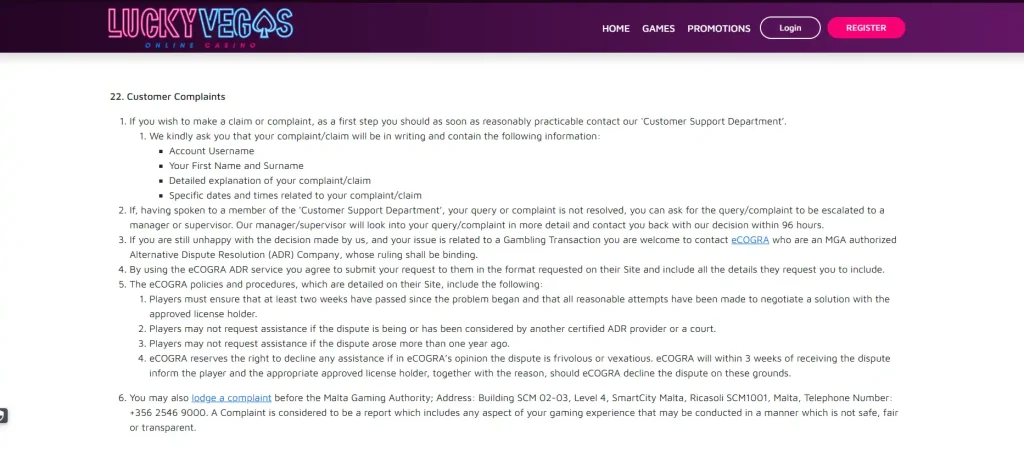
Lucky Vegas terms set out the formal complaint route and the named escalation path.
Lucky Vegas complaints are useful as signals about the kinds of problems individual players say they have faced, but they are not the same thing as verified evidence about the operator’s licence, rules or formal dispute process. A review comment can describe one person’s experience. The UK Gambling Commission register can establish the operator and licence status. Lucky Vegas’ own terms set out the complaint route. Those sources answer different questions and should not be blended into one verdict.
In the UK context, the practical route is straightforward: preserve the facts of the dispute, contact Lucky Vegas support in writing, follow the internal escalation route if the issue remains unresolved, and use the named alternative dispute resolution route where the terms say it applies. Live chat and email support are available, with support email listed as [email protected]. The sections below explain how to read reputation evidence without treating anecdotes as proof.
What player complaints can tell you
Player complaints can reveal recurring themes worth investigating. If several people independently describe difficulty understanding a bonus condition, repeated requests for verification evidence, account restrictions or delayed communication, those reports can help a customer decide which terms to read before depositing. They can also identify questions to ask support. That is useful information even when no individual complaint can be independently proved from outside the account.
The limitation is equally important. A complaint normally comes from one side of a private account history. Public customers usually cannot see the complete transaction record, verification requests, timestamps, internal risk checks or messages exchanged with the operator. That makes the report an anecdotal data point rather than a complete finding of fact. A positive review has the same limitation in reverse: one smooth experience does not prove that every user will get identical service.
Small review samples can change quickly. A few recent comments may dominate the visible tone even though they represent a tiny fraction of customers, while star averages can mix old and new experiences from different countries and products. Specific recurring issues are more useful than a single reputation score when they are compared with current terms, regulator records and the operator’s formal response process.
Complaints about withdrawals are a good example. A player report may tell you that a withdrawal felt slow, but the exact cause could involve verification, payment ownership, a payment provider or an account-specific review. The Lucky Vegas Withdrawals section covers the supported withdrawal process rather than treating one anecdote as a universal processing-time promise.
Lucky Vegas official complaint route
The current Lucky Vegas terms set out a written complaint process. The useful first step is not simply to post a public review, but to send a clear account of the issue to Customer Support so that the operator can identify the account, transaction or event being disputed. The terms also provide for escalation to a manager or supervisor when a complaint is not resolved at the first stage.
Written communication matters because it creates a record. A concise complaint should identify the account holder, the relevant date, the transaction or game involved where applicable, the amount in dispute if there is one, and the outcome being requested. It should also attach or reference any useful supporting material such as screen captures, payment confirmations or earlier support messages. The aim is to make the issue reproducible rather than emotional.
Lucky Vegas offers live chat and email support, and the support email is [email protected]. Live chat can be useful for immediate clarification, but for a formal dispute it is sensible to preserve the conversation or follow up in writing. That gives both sides a common record of what was reported and when. The complaint terms state an escalation path to a manager or supervisor, so a player should distinguish between an initial support query and a complaint that has formally moved to the next internal level.
The terms mention a decision within 96 hours at the internal escalation stage. That wording should be read as part of the operator’s current complaint terms, not as a guarantee that every underlying account issue will be fully resolved in four days. A complex verification, payment or third-party provider question can have separate dependencies. The key value of the time wording is that it gives the player a defined point at which to ask whether the complaint has entered the stated escalation process.
Support availability is not the same as complaint outcome. A responsive chat agent can help collect information, but the merits of a dispute depend on the account evidence and terms. Conversely, a frustrating support interaction does not by itself prove a breach of licence conditions. Keeping process and conclusion separate makes escalation more effective.
ADR route in the current terms
Lucky Vegas’ current terms name eCOGRA as an alternative dispute resolution route for unresolved gambling-transaction disputes after the internal process. ADR exists to provide an external route for eligible disputes without turning every disagreement into a regulator complaint. The exact scope matters: the named route is connected to unresolved gambling-transaction disputes, so a user should first establish that the issue falls within the ADR service’s remit.
Before escalating externally, keep the final response from the operator and the supporting records together. An ADR reviewer needs a clear chronology. That can include when the transaction took place, when the complaint was first raised, what evidence was supplied, what responses were received and why the player believes the final outcome does not match the applicable terms or account facts.
ADR should also be distinguished from the UK Gambling Commission. The Commission regulates licensees and can act on compliance issues, but it is not generally a service for deciding an individual customer’s monetary dispute. An ADR body is designed for the eligible dispute itself. This distinction helps prevent a common dead end where a player sends a personal payment disagreement to a regulator expecting the regulator to adjudicate the account balance.
If the matter concerns a gambling transaction and Lucky Vegas’ internal process has been exhausted, the named eCOGRA route is therefore more relevant than a public review score. A review platform can make an experience visible; ADR can assess an eligible dispute through a formal process. Those are different functions.
How reputation differs from regulatory status
Lucky Vegas’ Great Britain licence facts are independently checkable. The UK Gambling Commission register lists Skill On Net Limited under account 39326 and shows an active remote casino licence. The same public record connects Lucky Vegas to that operator. That is a regulatory fact, not a popularity measure.
A complaint cannot erase an active licence entry, and an active licence entry cannot prove that every complaint is unfounded. They operate on different evidence layers. Regulation establishes who the licensed operator is and which permissions are active. Reputation evidence describes how customers say the service worked for them. Formal complaint records and ADR outcomes sit between those layers because they relate to specific disputes using structured procedures.
This is why broad labels such as “trusted” or “untrustworthy” can hide more than they reveal. A stronger method is to ask narrower questions. Is the operator identity verifiable? Yes, through the UKGC register. Is there a written complaints process? Yes, in the terms. Is an ADR route named? Yes, eCOGRA is named for unresolved gambling-transaction disputes. Are individual public complaints automatically proved? No, not without the underlying account evidence.
For the licence evidence itself, see the Lucky Vegas Licence, Operator and Trust page. Keeping that regulatory check separate from reputation material makes it easier to understand what each source can actually establish.
What to document in a dispute
A well-documented dispute is easier to understand than a long narrative with missing dates. Start with a simple timeline: account event, transaction, support contact, document request, response and escalation. Keep the original wording of messages where possible rather than rewriting them from memory. Record transaction identifiers or game-round references if the interface provides them.
Save screen captures that show the relevant screen, but avoid editing them in a way that removes context. Payment evidence should show enough to identify the transaction while protecting unrelated financial information. If verification is involved, note exactly what the operator requested and when it was supplied. Do not post identity documents publicly just to prove that a complaint exists.
For bonus disputes, preserve the promotion wording that applied when the offer was accepted. For game disputes, record the game name, date and approximate time. For withdrawal issues, keep the withdrawal request details, any verification messages and payment correspondence. The goal is to connect the complaint to specific account events.
Finally, keep the complaint itself concise. State the issue, the evidence, the relevant term if known and the remedy requested. That structure is more useful to support, a manager or an ADR reviewer than a general statement that the casino is “bad”. If you are still deciding whether to use the brand at all, the broader Lucky Vegas Casino Review separates product features, payments and licence evidence from complaint sentiment.
How to read Lucky Vegas complaints without confusing them with licence facts
Different sources answer different questions. The regulator is the place to check licence and operator status; the casino terms set out the complaint procedure and contractual rules; account messages and receipts are the most useful records for an individual dispute; ADR is the formal route for eligible unresolved transaction disputes. Public reviews can highlight recurring themes, but they do not replace those sources.
This distinction avoids two opposite mistakes. The first is assuming an active licence means no customer can have a legitimate complaint. The second is assuming a strongly worded review proves systemic misconduct. Neither follows from the evidence available to a public customer.
For Lucky Vegas in Great Britain, the position is straightforward: Skill On Net Limited has an active UKGC remote casino licence, the brand has a written internal complaint route, and the current terms name eCOGRA for unresolved gambling-transaction disputes. If you have a problem, keep the relevant account records and use that process. If you are researching reputation before playing, read complaints for recurring themes, then check those themes against the terms and regulator record before drawing a conclusion.