
Lucky Vegas Safer Gambling Tools UK
 Available in GB
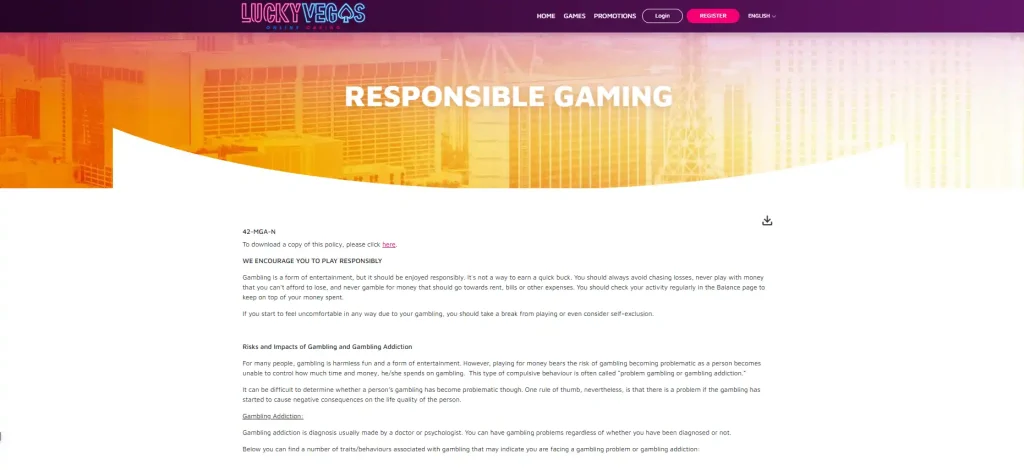
Lucky Vegas responsible-gambling information describes account controls such as limits, time tools and self-exclusion.
Lucky Vegas provides account-level safer-gambling tools including deposit limits, self-exclusion, time or session controls and reality-check style reminders. Great Britain players also sit within the wider UKGC framework, which includes GAMSTOP checks and financial-vulnerability requirements for remote licensees. These are different layers: some tools are settings a customer can choose, while others are regulatory obligations on the operator.
A revised UKGC Remote Gambling and Software Technical Standard takes effect on 30 September 2026. It requires remote systems to offer gross deposit limits and reserves the term “deposit limit” for limits that match that definition. Until that date, the previous terminology remains in force. Slot stake caps are a separate control and should not be confused with account deposit limits.
Lucky Vegas account controls
Lucky Vegas provides four relevant account-control categories for a Great Britain player: deposit limits, self-exclusion, time or session controls and reality or game-status reminders. Each serves a different purpose. A deposit limit controls how much money can be added over a defined period. A time control focuses on access or session duration. A reality reminder interrupts continuous play with information that helps the customer reassess the session. Self-exclusion is stronger because it is intended to stop access rather than merely slow or budget it.
These controls work best when selected before a problem emerges. A customer who has already decided on a gambling budget can set a financial boundary before making repeated deposits. A person concerned about long sessions can use time-oriented controls instead of relying on memory while playing. A reminder is useful when the aim is awareness, but it should not be treated as equivalent to self-exclusion if the customer wants gambling access blocked.
Account-level controls also sit beside the operator’s wider customer-interaction obligations. A player setting a limit does not remove the operator’s responsibility to respond to risk indicators, and an operator intervention does not stop a customer from using their own controls. The two layers can operate at the same time.
The practical starting point is to decide what needs controlling: money entering the account, time spent gambling or access to gambling itself. Then use the tool that matches that objective. A limit should be set at a level chosen from an affordable entertainment budget, not from an expectation of winnings. If circumstances change, the safer response is to reduce exposure rather than use a higher limit to chase previous losses.
It is also useful to check how a chosen control behaves before relying on it. A player should know when a limit period resets, what happens if an increase is requested, and whether a time-out or self-exclusion can be reversed during its active period. Those operational details should be read in the current account interface because they can change independently of the general control categories. For the underlying account structure and identity requirements, see Lucky Vegas Registration and Account Setup.
GAMSTOP and self-exclusion
GAMSTOP is the national online self-exclusion scheme for people in the UK. It is not simply another toggle inside one Lucky Vegas account. Remote gambling companies licensed by the Gambling Commission participate in the scheme, so a GAMSTOP exclusion is designed to operate across licensed online gambling businesses rather than at only one casino.
That makes GAMSTOP different from operator-level self-exclusion. A Lucky Vegas self-exclusion applies within the operator relationship, while GAMSTOP is intended to create a wider barrier across participating licensed services. A customer choosing between them should think about the scope required. If the objective is to stop online gambling access across licensed operators, a national scheme addresses a broader problem than a single-site setting.
Identity accuracy matters here as well. Self-exclusion systems depend on matching customer information. Registration details should therefore be truthful and current. Trying to bypass an exclusion by changing superficial account details conflicts with the purpose of the control and can create further account and verification issues.
Self-exclusion is not a budgeting technique. It is an access restriction. Someone who simply wants a spending boundary may find a deposit limit more appropriate, while someone who wants to stop gambling should use the stronger exclusion route. The distinction helps prevent a weak tool from being used for a goal it cannot reliably achieve.
A GAMSTOP registration also should not be treated as a temporary inconvenience to work around. Its purpose is to create distance from online gambling across the licensed market. If a customer has chosen that route, opening substitute accounts or searching for ways around matching checks undermines the protection they deliberately activated. Operator-level controls remain useful for customers who do not need national self-exclusion but still want structured boundaries.
Financial vulnerability checks
Great Britain remote operators also have a regulatory financial-vulnerability check requirement. The current UKGC rule says a licensee must perform a financial vulnerability check when the relevant threshold is met. Since 28 February 2025, the threshold is where deposits minus withdrawals exceed £150 in a rolling 30-day period. The check uses customer-specific public-record information for significant indicators of financial vulnerability, including matters such as bankruptcy or specified debt judgments and arrangements.
This is a regulatory operator process, not the same thing as a customer choosing a deposit limit. Reaching the threshold does not mean a customer has been declared unable to afford gambling. It triggers a defined check. The operator must consider the information obtained alongside what it already knows about the customer, assess risk and take proportionate action when risk is identified.
The Commission describes these as light-touch checks using public information. Separate financial risk assessments for unusually high spending are a different framework and should not be confused with the existing vulnerability check.
For a player, the useful takeaway is that an account can be subject to regulatory checks even if the player has not manually turned on a safer-gambling setting. Personal controls and operator compliance processes are complementary rather than interchangeable.
Deposit-limit rule from 30 September 2026
The regulatory wording changes on 30 September 2026. From that date, the UKGC’s revised RTS 12B requires remote gambling systems, as a minimum, to offer gross deposit limits. A gross deposit limit caps the amount a customer deposits into the account over a defined duration without subtracting withdrawals. Only a limit meeting that definition can be called a “deposit limit” under the revised standard.
The standard also requires the periods offered to include 24 hours, seven days and one month. If a customer sets limits across more than one time frame, the most restrictive applicable limit must control what can be deposited. Once the limit is reached, the system must prevent further deposits until the period restarts or the customer takes action to increase the limit, subject to the standard cooling-off rule.
Other financial controls can still exist. The UKGC guidance distinguishes stake limits, loss limits and net deposit limits from the gross deposit limit. A net deposit limit subtracts withdrawals during the relevant period, while a gross deposit limit does not. This naming rule is intended to make it clearer what a customer is actually restricting.
The revised standard also requires financial-limit facilities to be easily accessible from registration onward. Customers must be prompted to set a limit during registration or when making the first deposit or payment. That prompt does not mean every customer must choose the same amount. The regulatory goal is to make the control visible and usable at the point where an account begins to be funded, rather than burying it behind later settings.
The revised definition takes effect on 30 September 2026. From that date, the gross-deposit-limit requirements and naming rule apply as specified by RTS 12B, while the statutory online-slot stake caps remain a separate product rule.
How these controls differ from slot stake limits
Deposit limits govern money entering an account. Great Britain online-slot stake limits govern the maximum stake per game cycle on online slots. They operate at different points and should not be combined into one number. The current statutory slot caps are £5 per game cycle for customers aged 25 and over and £2 per game cycle for customers aged 18-24.
A player can therefore be below a deposit limit but still be constrained by the per-cycle slot stake cap. Equally, using lower stakes does not mean deposit controls are irrelevant, because repeated deposits can accumulate independently of the amount placed on one spin. One rule is about funding the account; the other is about the stake on a specific regulated product.
The stake caps described here apply specifically to online slots, not automatically to every casino product. The age bands and slot rules are covered in Lucky Vegas Slot Limits and Rules.
Keeping those layers separate makes safer-gambling settings easier to use. A customer can choose an account budget through financial controls while statutory product rules continue to apply automatically where relevant. Neither control should be presented as a substitute for the other.
How Lucky Vegas account controls fit the current Great Britain framework
Lucky Vegas’ deposit limits, self-exclusion, time controls and reality reminders give customers several ways to manage an account. GAMSTOP provides a broader national self-exclusion route, while UKGC rules add operator duties such as financial-vulnerability checks. The revised gross deposit-limit standard then changes the required terminology and minimum functionality from 30 September 2026.
A practical control plan begins with the intended outcome. Use a financial limit when the objective is to cap funding, time controls when the objective is to contain session length, and self-exclusion when access itself needs to stop. If a broader block across licensed online gambling is required, GAMSTOP operates beyond a single Lucky Vegas account.
The Lucky Vegas Licence, Operator and Trust page explains the Great Britain licensing context behind these duties. For the casino as a whole, the Lucky Vegas Casino Review connects these account controls with games, payments and mobile use. This makes it easier to distinguish controls chosen by the player from obligations imposed on the operator.